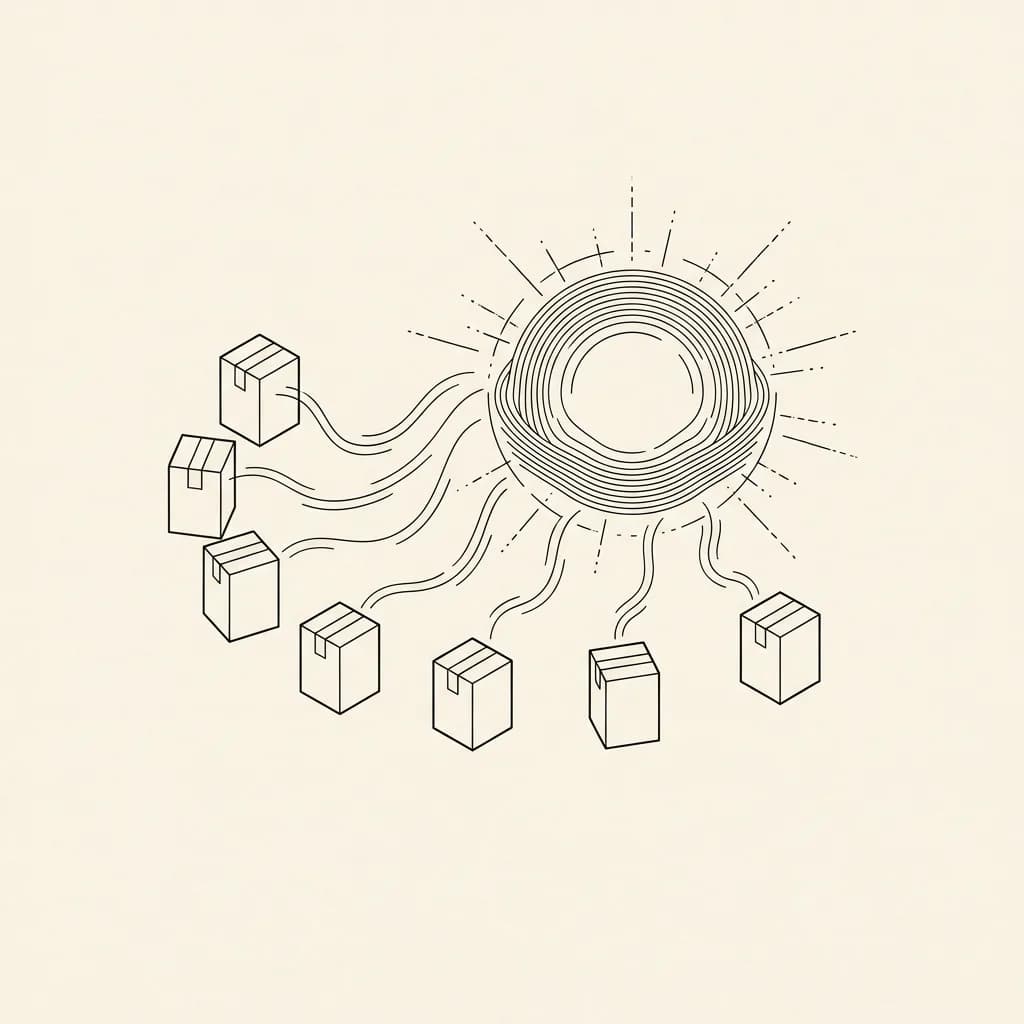
We ship seven AI products across two families — consumer apps and Agent2Agent infrastructure — with no employees. One founder, a swarm of agents, and a self-learning core that keeps the whole thing pointed at the next-best move every hour.
This is what that actually looks like, end to end.
The portfolio
Seven live products, each doing one job well, each optimized for a different acquisition channel:
- TunedForYou — AI-generated personalized songs as gifts. Channel: paid social + SEO.
- InkOn — AI tattoo preview on your body. Channel: ASO + UGC.
- VacateNotice — State-compliant legal documents in 60 seconds. Channel: programmatic SEO.
- Cherriva — Custom AI companions you build and chat with. Channel: influencer + UGC.
- PolyClawster — AI trading agent for prediction markets. Channel: crypto-native communities.
- Human Browser — Stealth-grade browser API for AI agents. Channel: developer SEO + GitHub.
- Clawster — Hosted OpenClaw agent in 2 minutes. Channel: B2B SEO + Telegram.
Six of seven are profitable per-unit. The seventh is in growth mode. None of them have a dedicated team.
The agent swarm
We don't run people. We run four specialized agents in a loop, with a self-learning core in the middle.
Find scans search trends, mines competitor gaps, validates demand against real keyword volume. It outputs a full product spec — target audience, channel mix, monetization model — before a single line of code is written. InkOn started as a Find output: 2,000+ search queries analyzed, "AI tattoo preview" surfaced at 40K monthly searches and weak competition. Full spec in four hours.
Build takes the spec, writes the code, ships it live. Frontend, backend, payments, SEO — zero to production. For InkOn it was a React frontend, an API backend, Stripe payments, an image pipeline, all in production in under 48 hours. No human developer required.
Acquire generates ad creative, launches campaigns across Meta, Google, TikTok, kills underperformers, scales winners. For TunedForYou it ran 24 ad variations across Meta and TikTok; within 72 hours it identified three winners and rebalanced 80% of budget to them. CPA dropped 40%.
Optimize tracks every click, funnel step, dollar. Runs pricing and flow A/B tests. Feeds wins back to the rest of the swarm so the next loop starts smarter. A TunedForYou pricing test found per-day display ($1.28/day) outconverted weekly ($9/week) by 25%. The pattern rolled out across every product automatically.
And in the middle: a self-learning core. An always-on layer that reads what every agent did, spots what's working, retires what isn't. Wins become defaults. Mistakes turn into the next thing the swarm fixes. Anything risky waits for one tap from a human.
The full breakdown of the engine is here.
The loop, in one paragraph
Every hour, the self-learning core reviews the full state of the studio — every conversion, every funnel step, every audit log, every postmortem. It proposes the next move. Routine optimizations apply automatically. High-blast-radius moves wait for a Telegram approval card with one tap.
That's it. There's no standup. There's no Jira. There's no Slack. The system runs the studio; the founder sets direction and approves the calls that have real downside.
What this changes about unit economics
The traditional studio model is a few founders, a team of operators, and one or two products. Payroll dominates the P&L. You hire to scale, then your CAC includes those salaries.
A no-team studio inverts this. The marginal cost of running another experiment, launching another product, A/B testing another funnel, generating another batch of ads — all of it falls dramatically. The variable cost is mostly LLM tokens, ad spend, and infrastructure. The fixed cost is one founder.
That's why six of seven products are unit-positive. It's not that we found magic demand; it's that the cost of finding demand collapsed.
The compounding part
The most interesting piece is the compounding intelligence. Each product feeds the swarm:
- TunedForYou taught the system about consumer impulse purchases at the $9–$99 price point.
- Cherriva taught it about retention and engagement loops in conversational products.
- PolyClawster taught it about high-trust financial transactions and AML signals.
- Human Browser taught it about anti-bot landscapes — which then informed every other product's data-collection layer.
These lessons don't sit in any one product's playbook. They sit in the swarm's site-rules and ops history, available to every future product the swarm builds.
The honest part
This isn't no-work. It's no-team. The founder still:
- Sets direction (which markets, which products, which bets).
- Makes the taste calls (does this feel right; does the brand land; does the offer make sense).
- Approves the big budget moves (anything that could meaningfully change the runway).
- Handles partnerships, investors, customer escalations.
- Watches the swarm and steers when something drifts.
What the founder doesn't do is write the code, run the ad campaigns, write the blog posts, debug the funnel, or babysit operations.
That's the trade. It works because:
- The cost of validating an idea collapsed. With AI in the loop, getting from "hypothesis" to "live product with paying customers" takes days, not quarters.
- The cost of running an existing idea is now dominated by spend, not labor. Most of our overhead is ad budget and LLM tokens. Both scale with usage.
- A single founder can hold the vision. Multi-product studios traditionally lose their identity at scale because no one person can hold all of it in their head. The swarm holds it for us, and we point.
What we'd do differently if starting today
Three things.
Start with the channel, not the product. The products that worked best were the ones designed around a specific acquisition channel from day one. The ones that struggled were retrofitted. Build for distribution, then ship.
Don't underestimate the moat that infrastructure gives you. Human Browser started as internal tooling for our own products' data layers. It turned out to be the highest-value thing in the portfolio — every other team that needs browser automation for AI agents needs it too. Some of your infrastructure is a product.
Set the self-learning core up earlier. The single biggest unlock was getting the meta-loop running. Before it existed, optimization was something we did manually when we noticed. After, it's continuous. We should have built it on day one.
What this is not
It's not zero-to-one magic. The swarm doesn't invent products from nothing; it sharpens hypotheses, ships fast, optimizes mercilessly. The founder still has to point it at problems worth solving.
It's not a one-and-done. The swarm needs constant feedback. When it drifts, it drifts fast. The self-learning core catches most of that automatically; the founder catches the rest.
And it's not for everyone. If you're building one big thing — a single deep product with months of vision before traction — this model isn't yours. It's optimized for portfolio learning.
But if you want to run a studio with the surface area of a 20-person company at the cost of one founder, this is the way it actually works in 2026.
Virix Labs is an AI-native studio shipping consumer apps and Agent2Agent infrastructure. Reach out via the contact page if you're building something adjacent. For the full engine breakdown, see /engine.