There's a number that shows up in every "services are the new software" essay: for every $1 businesses spend on software, they spend roughly $6 on the people who do the work around it. Sequoia used it. A dozen think pieces used it after. The claim is that AI collapses that $6 into software-margin revenue, and the company that pulls it off is the next trillion-dollar business.
The ratio is real. What's missing from almost every essay is the boring part: what the company that captures it actually looks like on a Tuesday. Which work the AI does, which work it can't, who is still in the loop, and where the margin comes from once you stop selling seats.
We run seven products as an AI-native studio. Most of the work — writing, media buying, support, reconciliation, QA — is done by software agents, not employees. This is what we've learned about services-as-software from actually operating it, not theorizing about it.
"Services-as-software" is a delivery model, not a pricing trick
The first misread is that services-as-software means "SaaS, but we bill on outcomes." Outcome pricing is a consequence, not the thing itself.
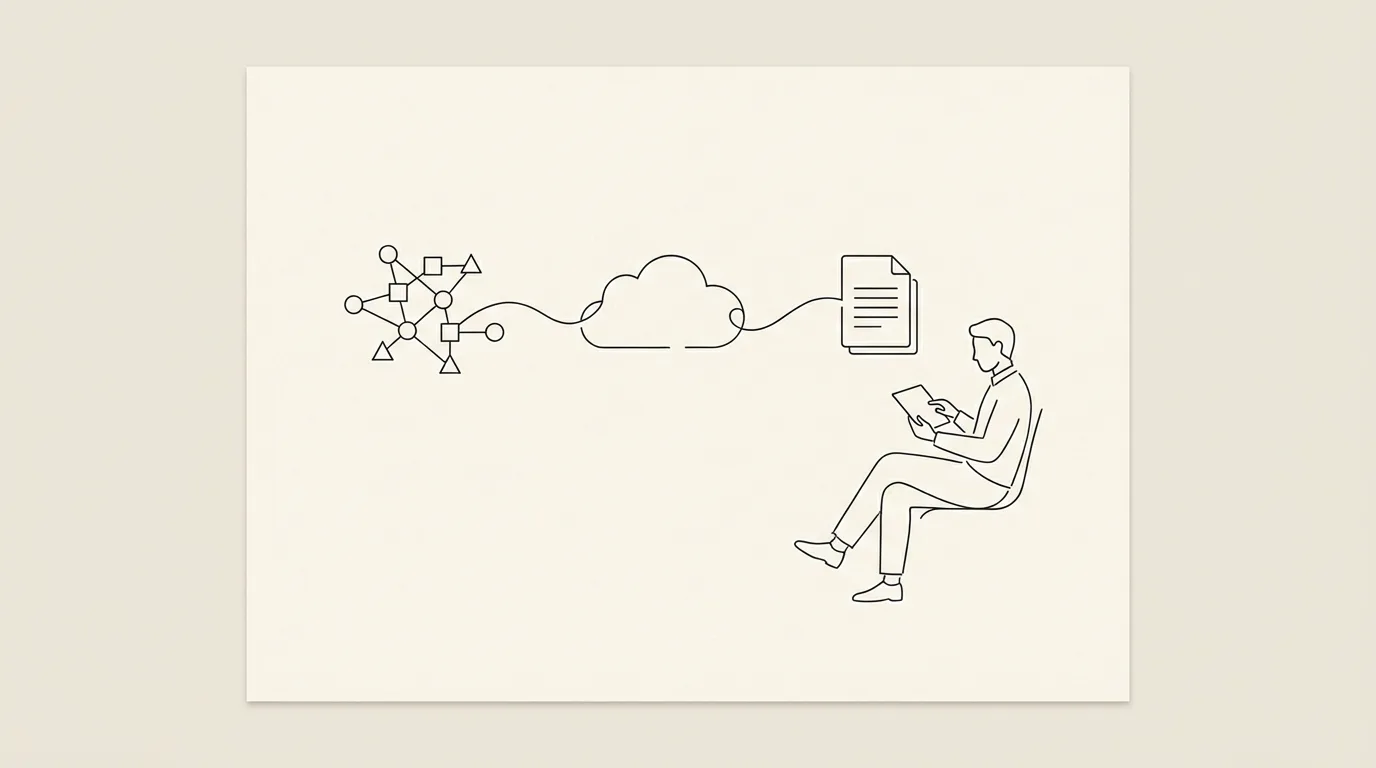
The actual shift is in who does the work. Classic SaaS sells you a tool and hopes your team uses it well. A services-as-software company delivers the finished work and hands you the result. The customer never touches the tool. They don't get a dashboard with 40 features they'll never open — they get leads in their CRM, resolved tickets in their queue, paying customers in their dashboard.
Once the work is delivered rather than licensed, outcome pricing becomes obvious, because now there's an observable outcome to price against. You can only sell "per paying customer" if you're the one actually producing paying customers. Pricing follows delivery. Not the other way around.
The work that automates — and the work that stubbornly doesn't
The honest version of this thesis has a line down the middle.
Automates well (agents do it, at software margin):
- Drafting and iterating content, creative, and copy at volume
- Running and optimizing paid campaigns against a target CPA
- First-line support and triage
- Data reconciliation across systems (the classic $6 spent on someone matching two spreadsheets)
- QA, monitoring, and the "did the thing actually work" verification loop
Doesn't automate (a human is still the point):
- The relationship. Someone senior still closes the deal and owns the account.
- Judgment on irreversible calls — spend ceilings, brand risk, anything legal.
- The 5% of edge cases that break every automated flow. You need a person who can log in, look at the real screen, and unstick it.
- Trust. A client hands you their funnel and their money. That decision is made human-to-human, every time.
The mistake that kills services-as-software companies is pretending the right column is empty. It isn't. The winning shape is 90% agent, 10% human — but the 10% is load-bearing. The company that automates the relationship and the judgment doesn't scale; it churns.
Where the margin actually comes from
Three places, in order of how much they matter:
- Labor arithmetic. The $6 was mostly salaries. If agents do 90% of the delivery, most of that $6 converts to margin. This is the headline and it's genuinely true.
- Compounding, not linear, capability. This is the part the essays miss. A pure agency's cost scales with headcount. An AI-native studio's cost scales with tokens and infrastructure, and its capability compounds — every product's data makes the next one's agents better. We've watched a monitoring pattern learned on one product prevent an outage on another. Agencies can't do that; their "learning" walks out the door at 6pm.
- Retention. Outcome-billed customers stay longer, because the value is legible every single billing period. There's no "are we getting our money's worth from these seats" conversation, because there are no seats. There's a number: results delivered, this month.
Margin one is arithmetic. Margins two and three are the moat — and they only exist if you're actually AI-native, not an agency with a chatbot bolted on.
The tell: can it survive a real website?
Here's the practical filter that separates real services-as-software from the pitch deck version. Most of this work — media buying, support, reconciliation, posting, research — ultimately runs on other people's websites and platforms. Ad managers, CRMs, partner portals, support desks, social platforms.
The demo that impresses on stage breaks the moment the agent hits a real login wall, a captcha, an anti-bot check. Delivering the work means your agents have to operate the real internet, at scale, without a human babysitting every session — and gracefully hand the 5% they can't solve to a person who can. If a "services-as-software" company can't do that reliably, it's a services company with extra steps.
That infrastructure — agents that reliably operate real websites, plus a clean human-in-the-loop for the edge cases — is most of what we've spent two years building. It's also why we think the moat here is deeper than "we automated an agency." The automation is the easy part to claim and the hard part to run.
What this means if you're buying
If you're evaluating an AI-native services partner, the questions that matter aren't about the model — everyone will say "outcome-based." Ask:
- What percentage of delivery is actually automated, and what's still a person?
- When your automated flow hits the 5% edge case, what happens — does it stall, or does a human catch it?
- Does the vendor's capability compound across clients, or does every engagement start from zero?
- Are you paying for the result, or for access to a tool you now have to operate yourself?
The trillion-dollar version of this isn't a company that sells you better software. It's a company that quietly does the work, delivers the outcome, and only shows you the result. That's the bet, and it's the one Virix Labs Services is built to run.
Virix Labs is an AI-native studio: seven products across consumer and B2B, delivered and operated primarily by software agents with humans on the relationship and the edge cases. If you're thinking about services-as-software — as a builder or a buyer — we're easy to reach.