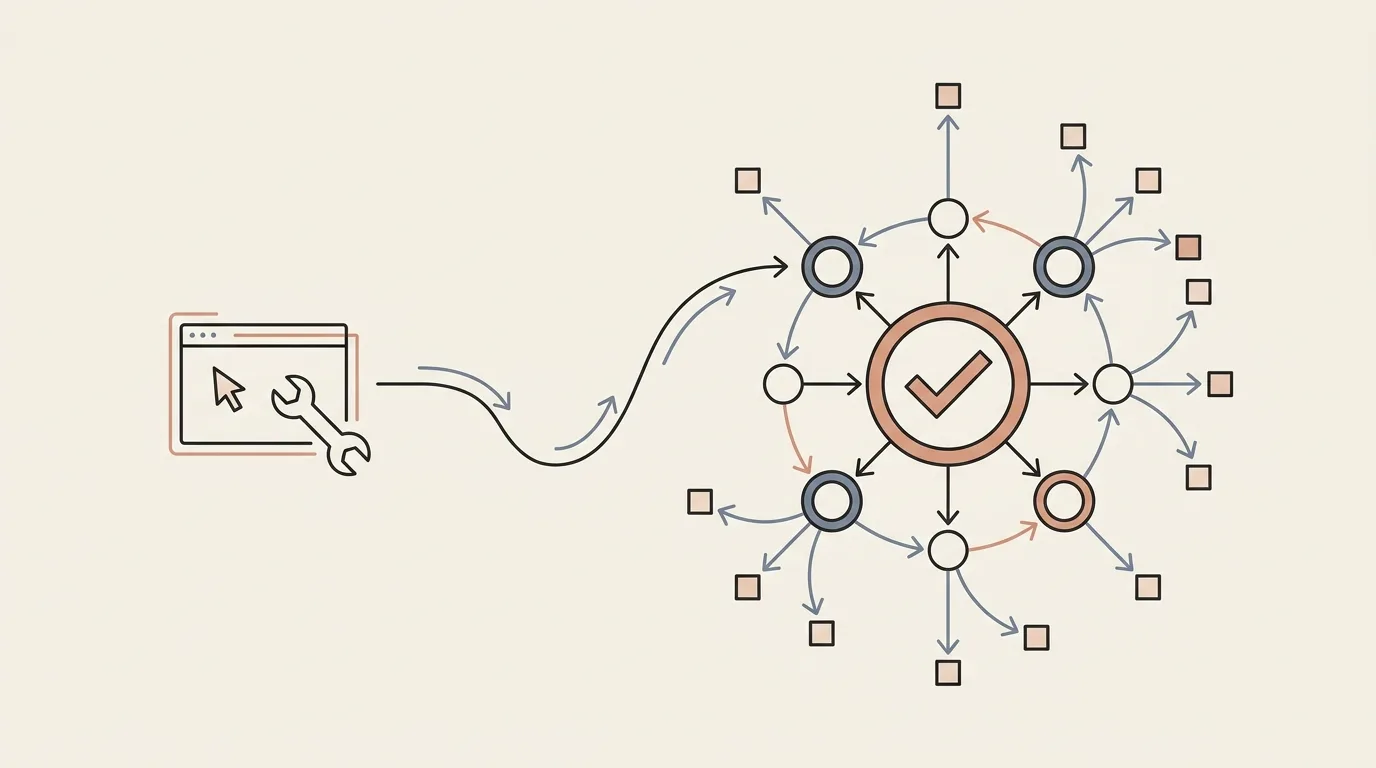
There's a line going around that sounds like a paradox until you sit with it: software is becoming marketing. The point is that when anyone can generate a working app in an afternoon, the app stops being the scarce thing. The code isn't the moat. Building it isn't the moat. What's scarce — and getting scarcer — is getting the work in front of the right person and actually delivering the outcome. Software becomes the top of a funnel, not the product.
If you believe that, a lot of strategy inverts. And it's the clearest way we know to explain why we build the way we do.
The thing that got cheap, and the thing that didn't
For thirty years, the hard, expensive, defensible part of a software business was building the software. Engineers were scarce. Shipping was slow. A working product was a real barrier to entry, and you could charge for access to it — per seat, per month — because access was the valuable thing.
AI collapsed that. Not to zero, but far enough that "we built a tool that does X" is no longer a moat. Your competitor builds it too, next week, with a fraction of the team. When the building gets cheap, the value doesn't disappear — it moves. It moves to the two things AI didn't make trivial:
- Distribution — being the one people actually find, trust, and choose.
- Delivery — actually producing the outcome in the customer's real world, not just handing them a tool and wishing them luck.
The essays call the first one "software is becoming marketing." The second one is the part they under-sell, and it's the one we bet the company on.
Selling a tool vs. delivering the outcome
Here's the split, concretely. Classic SaaS sells access: here's the dashboard, here are the 40 features, your team drives. The value you capture is capped by how good the customer is at using your tool — and by how easily a cheaper tool replaces you, because access is a commodity now.
Services-as-software sells the outcome: you never touch the tool. You get leads in your CRM, tickets resolved in your queue, campaigns running against your target cost-per-acquisition, orders in your store. The software is still there — it's just ours, on the back end, invisible. What we hand you is the result.
Once building is cheap, this is the only durable place to stand. You can't out-tool a market where tools are free. You can out-deliver it, because delivery on someone's real systems — at scale, reliably — is still genuinely hard. That difficulty is the new moat. It's exactly the moat that got vacated when the old one (building) collapsed.
Delivery is the new distribution
The subtle part: delivery and distribution are becoming the same thing.
When you sell a tool, distribution is a separate function — ads, sales, content, funnels — bolted onto a product. When you sell outcomes, the delivery is the distribution. A client who's getting paying customers every month doesn't churn and doesn't need re-selling; the result is the retention and the referral. There's no "are we getting value from these seats" conversation, because there are no seats — there's a number that shows up every billing period. The work markets itself by being done.
That's why "software is becoming marketing" and "services-as-software" are the same insight from two ends. If software is just the top of the funnel, then the bottom of the funnel — the actual outcome, delivered — is the whole business. We just chose to build the company at the bottom, where the value pooled.
What this requires that a tool doesn't
Standing at the delivery end has a cost, and it's worth naming because it's the filter.
Delivering outcomes means your agents have to operate the customer's real world — their ad platforms, their CRMs, their support desks, their partner portals, the messy live internet with its logins and captchas and rate limits. A tool company never has to survive that; they ship the dashboard and it's the customer's problem. An outcome company lives or dies on whether the work actually completes, unattended, at scale — and whether a human catches the fraction that breaks.
That operating layer is most of what we've spent two years building, and it's the reason we can credibly sell outcomes instead of access. It's also why we're not worried about the software getting cheap. Cheap software is our input, not our product. The product is the delivered result — and that's the part that stayed hard.
If you're deciding where to build
The takeaway isn't "SaaS is dead." It's that the defensible position moved. If you're starting something now, building the tool is table stakes and nearly free; the question is whether you own distribution and delivery, or whether you're selling access to a commodity and hoping.
We made our bet explicit: don't sell the software, deliver the work. That's what Virix Labs Services is — the outcome, produced by agents operating the real internet, with humans on the relationship and the edge cases. Software became marketing. So we stopped selling it, and started selling what it produces.
Virix Labs is an AI-native studio — seven products across consumer and B2B, delivered and operated primarily by software agents, with humans on the relationship and the edge cases. Reach us here.