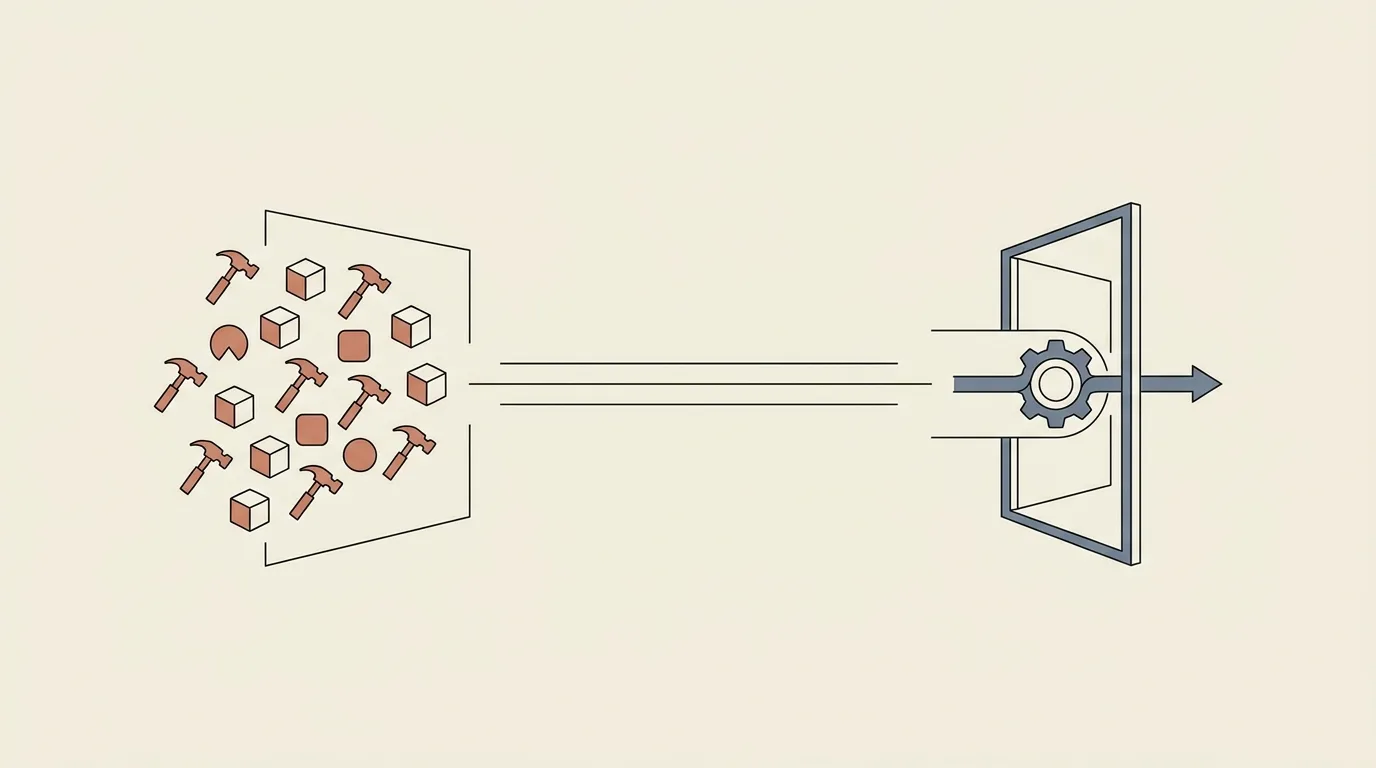
In 2025 and into 2026, something genuinely new happened: non-engineers started shipping real software. Not toys — working apps, internal tools, whole side businesses, built by describing what they wanted to an AI and iterating. Frameworks that make this easy saw sudden surges in usage. "Vibe-coding" went from a joke to a verb people put on their LinkedIn.
The common reaction is either "this is the end of software engineering" or "this is all slop that'll fall over." Both miss it. The interesting question isn't whether the code is good. It's: if building software is no longer the hard part, what is? Because the value didn't evaporate. It moved. And where it moved is the whole thesis of how we operate.
Building was the moat. Now it's the on-ramp.
For decades, the reason software businesses were valuable was that building software was hard. You needed engineers, time, and taste, and that combination was scarce enough to be a barrier. Charging for access to a working product made sense because getting to a working product was the expensive part.
Vibe-coding attacks that directly. When a founder can stand up a functional app in a weekend, "we built a working tool" stops being a differentiator — it's the starting line, available to everyone. This is the same shift the "software is becoming marketing" crowd is describing from a different angle: the artifact gets cheap, so the artifact stops being the moat.
The mistake is to conclude that nothing is scarce anymore. Plenty is scarce. It's just not the thing that used to be.
The bottleneck moved from "does it build" to "does it survive Tuesday"
Here's the gap every vibe-coded project hits, and it's the exact gap that separates a demo from a business.
Getting software to exist is now easy. Getting it to keep working, unattended, against the real world is as hard as it ever was — arguably harder, because the people building now often don't know what they don't know. The list of things that don't get vibe-coded:
- The app that logs into a third-party platform and survives its anti-bot defenses, session expiries, and rate limits — for weeks, without a human nursing it.
- The flow that handles the 5% of inputs that break every happy path, gracefully, instead of silently corrupting data.
- The system that notices when something upstream changed and adapts, instead of failing at 3am and staying failed.
- The reconciliation, the monitoring, the retries, the "did the thing actually work" verification loop.
None of that shows up in a demo. All of it is the difference between a weekend project and something a business can depend on. Vibe-coding moved the bottleneck from creation to operation — and operation is where it's stayed hard.
Why "operating" is the durable scarcity
Building is a one-time act; operating is a continuous one, and continuous reliability against an adversarial, changing environment doesn't collapse the way building did.
A model can now write the code that clicks the button. It's a completely different thing to have that click succeed reliably across thousands of sessions, on real websites that actively try to stop automated traffic, and to hand off cleanly the fraction that genuinely needs a human. That capability isn't a prompt. It's years of accumulated handling of real-world failure modes — the captcha that changed, the login that added a step, the platform that shipped a new defense on a Tuesday.
That's the layer that doesn't get commoditized by vibe-coding, because vibe-coding produces code, and this isn't a code problem. It's an operations problem wearing a software costume. The scarce thing is no longer "can you build it" but "can you run it, at scale, without it falling over" — and that scarcity is where durable companies now get built.
What we did about it
We didn't try to out-build the vibe-coders; that race is over and everyone won. We went to the other side of the moved bottleneck. We built seven products, and the actual asset turned out to be the operating layer underneath them — agents that reliably run work on the live internet, plus a thin human layer for judgment and edge cases. The building is the cheap part now; the operating is the moat.
So when people ask whether vibe-coding makes what we do less defensible, it's exactly backwards. It makes the old moat (building) worthless and the new one (operating) more valuable, because now everyone can produce software and almost no one can reliably run it against the real world at scale.
That's the bet, and it's the one Virix Labs Services is built on: not the code — anyone has the code now — but the delivered, operated outcome. Vibe-coding moved the bottleneck. We moved with it.
Virix Labs is an AI-native studio — seven products across consumer and B2B, delivered and operated primarily by software agents that run on the live internet, with humans on the relationship and the edge cases. Reach us here.