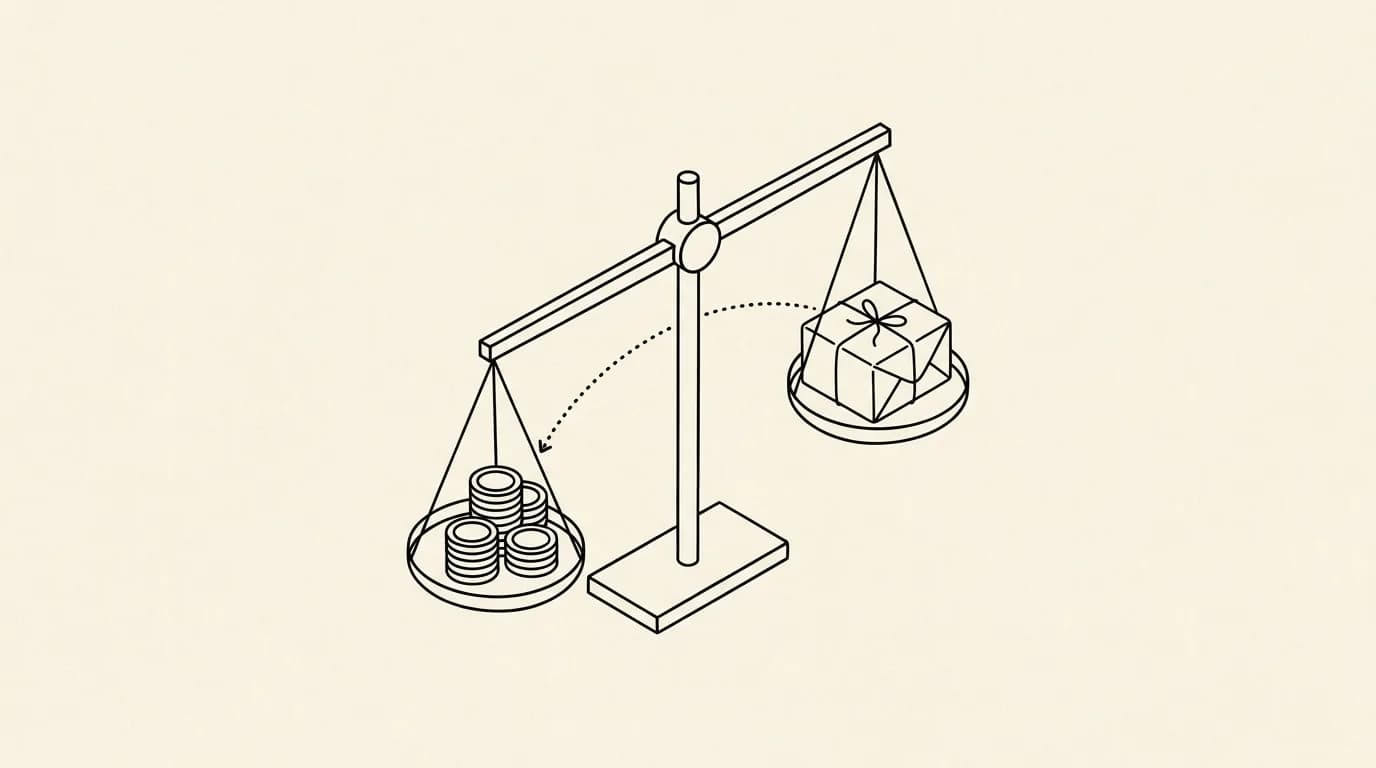
In April 2026, Sequoia partner Julien Bek published a piece arguing the next trillion-dollar company won't sell software — it will sell the work itself. AI-powered services with software margins. For every $1 spent on software, businesses spend $6 on services; the addressable market is six times larger when you sell outcomes instead of seats.
The post went viral on X, hit 3M views, kicked off a wave of "services are the new software" think pieces.
We'd already shipped most of what Bek described. Not because we'd seen the thesis — we hadn't — but because the customers told us what they wanted, and they didn't want seats. This is what outcome billing actually looks like, inside seven AI products that span B2C and B2B.
The shift Bek named
For thirty years, SaaS pricing has been per-seat, per-month. You bought 50 seats of Salesforce, you paid for 50 seats whether 30 of them actually logged in. The model worked because the alternative was on-premise software with even worse economics.
What changed in 2024-2026 is that AI got cheap enough to deliver the work itself, not just the tool to do the work. So now there's a real alternative: don't buy the seat — buy the result.
For a customer, the math is obvious. Buying a SaaS tool means hoping someone on your team actually uses it well. Buying an outcome means the result is contractually guaranteed. You pay for leads delivered, not seats provisioned. You pay for resolved tickets, not chat licenses. You pay for funded loans, not application portals.
For the seller, the math is also obvious. The TAM expands sixfold (Bek's $1:$6 ratio). The margin can still be software-grade (70%+) if the AI does most of the work. And — this is the part most analysts miss — outcome-billed customers stick around longer, because the value is observable every billing period.
The five products that pivoted
Of our seven products, five are now outcome-billed in some form. Two are still subscription/one-time because that's what works for those buyers. Here's how each one shifted.
TunedForYou — pay per delivered song
The original model was a subscription ($9/month for unlimited songs). The economics didn't work because the marginal cost of generating each song was real (Suno API + storage + human review when the lyrics got blocked).
We pivoted to per-song pricing — $9 for a quick delivery, $18 for the premium with extra revisions. Customers got exactly what they paid for; we got margin per transaction.
Result: revenue per active customer went up 3x. Churn dropped because there was nothing to churn from.
Cherriva — pay per conversation depth
Cherriva's original model was monthly subscription. The problem: heavy users were unprofitable (LLM costs scaled with usage), while light users felt they weren't getting value.
We added an outcome tier: pay per "deep conversation" (defined as 50+ message turns, measurable). Heavy users opted into it because they wanted unlimited access and were already paying for it. Light users stayed on the lower subscription.
Net: ARPU went up for the high-engagement segment, retention went up across the board.
PolyClawster — pay from profit, not deposit
This one was already outcome-billed from day one because the alternative didn't make sense. Polymarket trading via a bot isn't a service you'd subscribe to; it's a service that produces P&L. So we built it as 5% of profit on the user's positions, no monthly fee.
This is the purest outcome model in our portfolio. If the bot doesn't make the customer money, the customer pays nothing. If the bot wins $1,000, we get $50.
Human Browser — pay per completed run
The B2B model is per-completed-browser-task, not per-API-call or per-seat. A failed task (anti-bot block, tunnel error, captcha unsolved) doesn't bill. Only successful completions bill.
This is the model Bek describes most directly: the customer pays for the work, not for access to the tool. They don't care how many API calls we made or how many proxies we burned. They care that 1,000 logins succeeded.
Pricing: $0.01-$1 per completed run depending on complexity (simple scrape vs anti-bot-heavy checkout). At scale, this turns into $10-50k/month from individual customers, while still feeling cheap per unit on their side.
Clawster — pay per agent-hour
Hosted AI agent deployment, billed per active agent-hour. If the agent is idle, the customer isn't billed for the seat — the agent is paused.
This sounds like consumption pricing (AWS-style), but the framing is the outcome: "we ran your agent for 14.7 hours this month, here's the bill." Customers think of it as "what did the agent do," not "how much capacity did I reserve."
The two products we didn't pivot
Two stayed on traditional models, on purpose:
InkOn — freemium with a one-time upgrade. Outcome pricing for "preview a tattoo on your body" doesn't make sense — the outcome is the preview itself, which is the entire product. So we kept it freemium with a paid upgrade for unlimited generations.
VacateNotice — flat per-document fee. Same logic: the outcome IS the document. You don't pay per character or per state served. You pay for the finished, legally-correct document. $19 flat.
The lesson: outcome billing works when the outcome is a discrete, measurable thing that the customer cares about beyond just "using the product." When the product is the outcome, traditional pricing is fine.
The services tier we added
After watching the per-customer revenue dynamics on our B2B products (Human Browser, Clawster), we added a separate Services tier on virixlabs.com itself.
Three offerings, all outcome-billed:
- Performance Marketing — Meta + Google + TikTok ads, fully managed by our swarm. Pay per qualified lead or per sale, not a monthly retainer.
- Browser Tasks at Scale — pay per completed task. Higher volume tiers for $0.005 per run.
- SEO Rankings — pay when you rank top-3 on a target keyword, with a 90-day hold guarantee.
The pitch on the services page is exactly the Bek formulation: we sell outcomes, not seats. You pay for results, not access.
This is where the next year of company building is going for us. Most of our marginal revenue growth in 2026 is coming from outcome-billed services delivered by the same agent swarm that runs the consumer products.
The honest part
Outcome billing isn't free. There are real downsides that the think pieces gloss over:
The work is harder to predict. A customer who pays per lead has volatile bills. If your agent has a great month, you have a great month, and so does the customer's account payable. Some buyers want predictable invoices — they'll choose seat licensing even if it's more expensive, because finance prefers it.
The work is harder to deliver. You can ship a software product and call it done. You can't ship a "100 leads per month" promise and walk away. The service has to keep delivering. That's a meaningful operational lift; without an agent swarm, it's a 20-person ops team.
The work is harder to price. "We charge $99/seat" is easy. "We charge $300 per qualified lead" requires you to define qualified, measure it, validate it, dispute resolution when the customer disagrees. The pricing conversation is more sophisticated.
What makes it work for an AI-native studio: the agent swarm handles the delivery, the observability layer handles the measurement, the autonomous ops layer handles the dispute resolution edge cases. The pieces that used to require 20 ops people are handled by the same infrastructure that runs the swarm itself.
What this means for builders
If you're building an AI-native business in 2026, the strategic question isn't "which feature should I add to my SaaS?" It's "which customer outcome can I sell, and what's the unit economics if I deliver it?"
You don't have to abandon software entirely. We didn't. We have one-time products, subscription products, and outcome-billed products in the same portfolio. The mix depends on what the buyer actually wants.
But if you start with "what's the outcome," and you have a swarm that can deliver, the math is just better than the SaaS path. Six-times-larger TAM. Higher per-customer revenue. Stickier customers. Margin that approaches software-grade once volume kicks in.
That's the trade Bek described. We've been living it.
See the outcome-billed services we run for partners on the services page. Or read how we run 7 AI products with no employees for the operational view.